2:44 My Time, My Voice From Liuli China Museum
中 | EN
Juliette Leperlier’s studio is only a few minutes away from her great-grandfather François Décorchemont’s 19th century studio and not far from her uncle Antoine Leperlier’s current studio. And within its walls, her studio bears reminders of her late father Étienne Leperlier. Yet when asked to name the glass artists she most admires, absent from her list are the aforementioned names.
Juliette grew up within this family of French glass masters. As a youth, she distanced herself from her heritage, rejecting glass, especially Pâte-de-verre.
Pâte-de-verre is a complex and punishing practice that demands the artist to act as sculptor and craftsperson, to know the workings of a kiln and to have tremendous patience through the final cold-working and polishing stages. Trial after tribulation, it has been known to bring the artist more frustration than joy.
One must be deeply passionate about Pâte-de-verre to tackle its technique.
Although Juliette attempted to cast aside the shadow of her family’s legacy, she now acknowledges that, “Glass art is like a disease that lay dormant in my body.” There is no one else in the world like her, born and raised into these circumstances, witnessing up close and personal, the glory of French glass art. To others, this is simply art history, but to Juliette, it is her inheritance, her ancestry and now, a burden she must transcend.
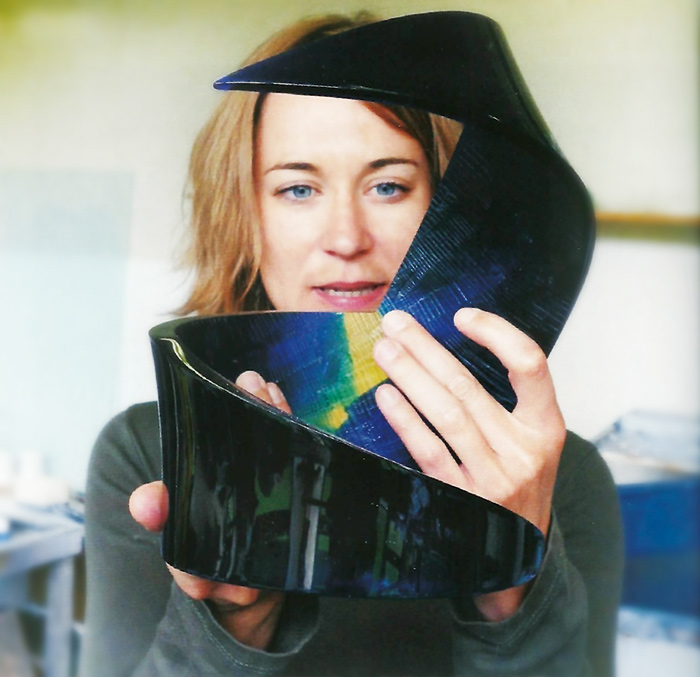
This challenge is what drives her because at the end of the day, she can not escape her name - Leperlier.
Today, you bear witness to an artist’s lifelong exploration through glass. Each piece offers a question and an answer in a never ending cycle. And through her hands, glass art has been ushered into a new era, shaping a new language.
Juliette Leperlier has released the philosophy and aesthetics of French glass art from its heavy past. Looking at the world with her own eyes, in her own style, we have a new possibility, a new name: We present Juliette Leperlier.